
Diane, remind me to make more than one part to this article. Make it a series.
Twin Peaks depicts American reality with greater fidelity than any non-fiction work. As in, it goes beyond being non-fiction, which tries to talk about reality as directly as possible. No, Twin Peaks is real.
I don’t mean that the things it says about America are true. I don’t mean it merges televisual pastiche into a total reflection of the American psyche as it existed on the airwaves at a certain period of time. I don’t mean the “real life” story of how it was made to reject a consumerist obsession with murder mysteries and then wound up cancelled because it was forced to give into this very audience appetite for tidy solutions to grizzly deaths is a literal living out of its central thesis.
I don’t mean Twin Peaks is real in any of those ways, although it is real in all of those ways.
What I mean is that down to the most surreal elements of it—the ritual killing of Laura Palmer, the Black Lodge and its archonic denizens, the use of electricity as a conduit for spirit beings, the Fireman in his castle on a giant purple sea—are completely real.
I don’t even mean that metaphorically. I don’t mean they symbolize real things.
I mean they are real.
The Little Man? He is real. He really exists. And you see him really existing when you watch the TV show.
I cannot stress this enough. When you watch Twin Peaks, you don’t see a show about him. You see him actually alive and well in your living room. The real Little Man.
Yes, an actor was given lines and makeup and placed on set. And that actor is not the Little Man. But the Little Man you see on your screen is actually the Little Man.
But to understand this, we’re going to need a lot more coffee and donuts.
It’s Time to Drink the Damn Good Coffee
Twin Peaks lives there at the edge of the continent of American television as a misty vision hidden among the pines. When you remind people of it, they smile and take a deep breath and look off into the distance, the notes of Angelo Badalamenti’s absolutely perfect score plucking in their heads.
It’s like a sip of the Double R’s coffee, brewed fresh.
But what goes into that cup?
Frost & Lynch: Wizard & Shaman
First, let’s examine the show creators Mark Frost and David Lynch to see what each brings to the table.
Mark Frost—as we can see from his books The Secret History of Twin Peaks and Twin Peaks: The Final Dossier—contributes much of the occult mythos and conspiracy world vibe that fill out the universe of the show. And that can get quite sweeping. The Secret History… alone combines characters from American history (including Lewis and Clark), famous UFO abduction cases, and ideas from esoteric spirituality to form the fictional ground that the characters and events of Twin Peaks exist inside of.
David Lynch, of course, brings his aesthetic sensibility and great big heart and surrealist approach.
What is that surrealist approach? To quote from his book Catching the Big Fish, he says:
Ideas are so beautiful and they’re so abstract. And they do exist someplace. I don’t know if there’s a name for it. And I think they exist, like fish. And I believe that if you sit quietly, like you’re fishing, you will catch ideas. The real, you know, beautiful, big ones swim kinda deep down there so you have to be very quiet, and you know, wait for them to come along.
Now, where is he going for these ideas? Let’s look at this clip from his talk Consciousness, Creativity, and the Brain:
Maharishi Mahesh Yogi teaches a technique called Transcendental Meditation… that allows any human being to dive within and experience subtler levels of mind and intellect, and transcend and experience this ocean of pure consciousness.
This pure consciousness is called by modern physics: “the Unified Field”. It’s at the base of all mind and all matter, and they now say, modern science says, all of matter and everything that is a thing emerges from this field. This field has qualities like bliss, intelligence, creativity, universal love, energy, peace and it’s not the intellectual understanding of this field but the experiencing of it that does everything.
You dive within and transcending, experiencing this pure field of consciousness you enliven it... This field is a field of pure knowingness. You dive in there and you sort of just know how to go. You know how to solve solutions. It’s like an ocean of solutions.
So then, Lynch mastered methods of going into higher states of consciousness to visit the oceanic great big consciousness at the heart of everything. That’s the body of water he went to for his idea fishing.
It calls to mind the methods of other surrealists from the past, like the great Salvador Dalí who captured dream images by drowsing off with a spoon in his hand suspended above a dish. When he slipped off to sleep, the spoon would fall, hit the dish, and cause a clatter—waking up Dalí, now with a fresh dream image in tow.
Mark Frost: Occult mythos. David Lynch: Surrealist approach.
These are not so far from one another, are they?
Frost is like the learned wizard who studies the ancient texts. Lynch is like the shaman who regularly meets with spirits.
Together, we get a sublimely complete picture of a magickal world.
And what kind of magickal world?
Because Twin Peaks began life as a TV show set in America, we got our first look into the mystery of this specific dreamworld. It’s an esoteric world directly witnessed and attested to (thanks to Lynch) made complete and coherent (thanks to Frost).
Invitation to America: TV, Electricity, and the Bomb
If Twin Peaks captured the authentic, contemporary American psycho-spiritual realm of the early 90s, it’s worth asking what that world was.
It seems that the three main pieces that go into this, at least as captured by the show, are: television, electricity, and the Bomb.
Together, they form a cohesive kind of America that was born in the aftermath of World War II. This culture formed the native ground for TV’s rise, and the culture was then informed and shaped by TV. It also is entirely post-electric—no fire needed. It’s a fully modern world in that sense, with light and manufacturing all completely controllable through the magic of electricity (the same kind that zaps over the studio logo for Lynch/Frost Productions at the end of every Twin Peaks episode).
All of that was set off in a new realm by the unimaginable horror of the Bomb.
Breaking apart these three key elements, we can get a better sense for the reality of Twin Peaks, and this may transform into tasting the reality being realized in Twin Peaks.
TV
Twin Peaks first aired on April 8, 1990. At that time, television broadcasts beamed out through the airwaves (this one on the American Broadcasting Company’s network, it should be noted). They were also sent along cable lines.
Television dominated the national consciousness, with the three (four?) major broadcasting companies (NBC, CBS, and ABC—also Fox) reigning large.
How large exactly?
The pilot episode of Twin Peaks received 34.6 million viewers. For context, the 1990 US census came in at the wildly exacting count of 248,709,873 people. That means 14% of Americans watched the premiere. That’s about 1 in 7 people.
Crazier than this? It didn’t even win ratings for the night. Just an hour earlier on the same network, America’s Funniest Home Videos had back-to-back episodes that absolutely crushed it—40.3 million and 39.8 million, respectively.1
Let’s sit with this.
The American psyche at the time focused in on shared fictional shows in a way hard to fathom on this side of Netflix streaming. It was, in effect, a collective dream we all tuned into at specific times each week, and tuning in felt important, because it was extremely difficult to rewatch old episodes.
Think about it like this: it was normal for people to hurry home to catch a TV show. They’d build the flow of their day around getting to see things as they aired.
And the shows really did “air”—they were beamed out into the air, invisibly passing through your body all the time. They also scurried down the wires hanging along the roadsides.2
Television at the time strived for a much broader audience than streamers produce today, and especially so for shows sitting in primetime slots on one of the major broadcasters. And they also were far less novelesque. Because so many viewers might miss episodes here or there and couldn’t easily go back to catch up, it was important that shows allowed you to drop in and know what was going on. This meant that episodes were more or less self-contained, and characters relied very heavily on archetypes that wouldn’t develop very much, lest they take on lifelike complications that would make it harder for a new audience member to immediately grasp them.
Like any other medium, it also took on a life of its own, gathering a favorite store of tropes and popular styles that helped bridge film’s montage effect with a rhythm that would get you to sit through regular commercial breaks.
Twin Peaks emerges at the very start of the 90s, and it makes use of all the tropes and aesthetic sensibilities that would have been familiar to viewers at the time. But being artists, Frost and Lynch pushed things further. They shunned the episodic, turning to the ongoing storytelling of soap operas (the 80s had a number of “primetime soaps” like Dallas, Dynasty, and Falcons Crest among others).
Lynch and Frost also employed a late 80s and early 90s TV aesthetic in a self-aware way. But they even went further back, drawing on American visual storytelling through the history of popular TV (something that really got going in the 50s).
They were making a show that looked like a TV show, and they also were making a show that looked like all TV shows ever.
This requires our immediate attention.
The show Twin Peaks looks like a TV show, if we merge all TV shows together in one general dream concept of what a TV show is.
Everything from the soundscape to the outfits to the sets to the dialogue evoke a “timeless” America, with a hard slant towards nostalgia for the 50s. That makes sense, as a 40-year-old in 1990 would have grown up in the 50s and early 60s (which were, to a large degree, a cultural extension of the 50s—right up until the end of the decade when things really started to change).
In a similar way, the characters are drawn from that set of archetypes that viewers would have been familiar with over those same decades. The high school bad boy Bobby, the tycoon bastard Ben Horne, the honorable Sherrif Truman, etc.
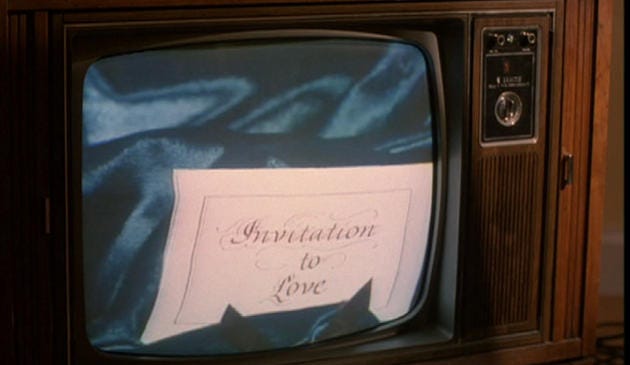
Even easier to grasp archetypes are employed for the TV-show-within-a-TV-show Invitation to Love, the daytime soap opera that people in Twin Peaks watch.
Before we move on, there’s one more vital part of television to share, and that’s the weekly murder mystery.
Television has always had a love affair with the hour-long procedural where a dead body is found at the beginning, and the murderer is discovered and put away by episode’s end.
For Lynch and Frost, this murder-of-the-week concept cut against all decency, because the victim never enjoyed real attention. Instead, the draw lies entirely with the detective and the killer.
Twin Peaks offered a radical new vision: one murder mystery that continues to unravel the secrets of a small Northwestern town. Rather than being a prurient dive into the killing of a young woman, it would deliver real heart. The mystery would draw viewers into the lives of characters, some of them truly good. The compelling storytelling might then help to heal something that had happened in the American psyche that led to us wanting to watch death after death after death.
Lynch puts it this way in Lynch on Lynch:
The mystery of who killed Laura Palmer was the foreground, but this would recede slightly as you got to know the other people in the town and the problems they were having. And each week would feature close-ups of some things. The project was to mix a police investigation with the ordinary lives of the characters.
Laura Palmer’s murder had to happen, then, in order for the show Twin Peaks to: exist, be compelling enough for people to watch, and heal America’s obsession with seeing death every week.
Electricity
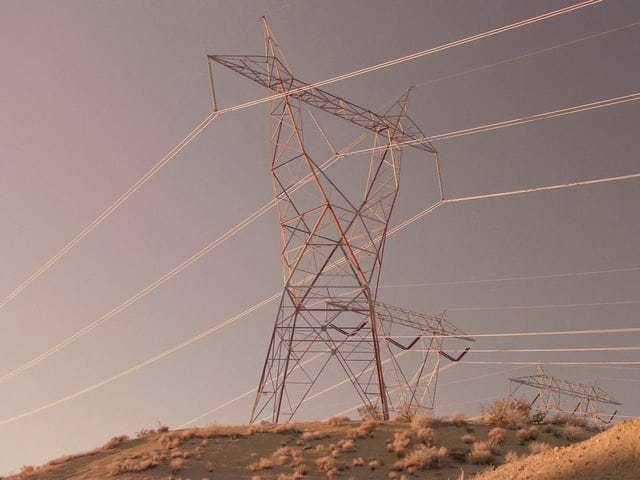
To spare readers in-depth recounting of events, let’s put it this way: it is widely accepted that the supernatural entities of Twin Peaks, particularly those who live in the Black Lodge, move through electricity.
Electricity changed America forever. While its earliest adopters pop up in the late 19th century, widespread electrification doesn’t take place until the 20s and 30s.
Electrification makes so much of the American lifestyle possible, not least of all television.
Electricity also channels fire—fire in the elemental sense of the term—in a way that defines our modern era. Once we fully electrified, we made a total break with the hundreds of thousands of years that our central technological relationship was with fire.
Fire makes all effort local. Even if you can get someone else to chop and deliver the wood (a massive ask and a huge task if you can’t get someone else), you’ll need to start the fire and tend it yourself. But with electricity, a flick of the switch brings on the lights, heats the food, and beckons actors to perform for you on the TV screen.
It represents everything remarkable about the way we live. For people reading this, it’s most likely literally unimaginable what it would be like to live any other way, but we’ve been raised in a truly Promethean world where near complete power over our nearby surroundings is possible.
Surely, given Promethean powers, nothing bad would happen.
The Bomb
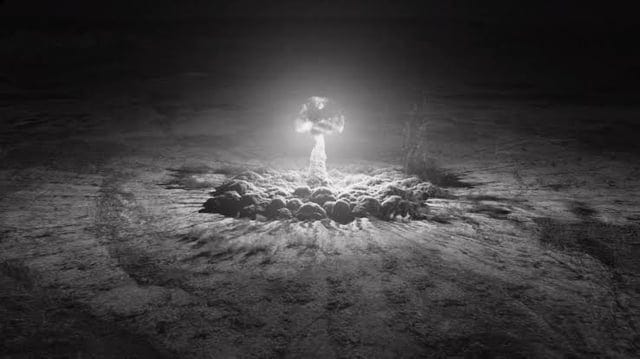
The final piece we need to put in place here? The Bomb.
Twin Peaks: The Return (aka Season 3) gave us a wealth of direct backstory. A lot of this appears in Part 8: “Gotta Light?”
Here, we are shown that the first detonation of a nuclear weapon in New Mexico3 catalyzed the birth of a series of beings, including BOB (a very evil entity), as well as the preparation of the convenience store that would serve as a meeting place for these beings. (That’s where Mike and BOB lived together.)
This emergence of dark spiritual beings prompts the Fireman in his seaside castle to produce Laura Palmer, who would go on to be sacrificed and, thus, create the means for there to be a Twin Peaks.
The nuclear bomb also marks the end of World War II, with the dropping of these terrifying weapons over Hiroshima and Nagasaki.
The end of World War II opens a period of regroup and societal rebirth in America, which solidifies into a new lifestyle in the 50s.
It is this time period that sees the rise of television.
When Twin Peaks first aired, it talked about a world made possible by electricity and a time marked off from the past forever by the detonation of the nuclear bomb. But the Bomb also shook loose old spirits from the land.
Dreams from an Older America
These key features of the America that Twin Peaks lives in fascinate, but they don’t alone prove that the show is real.
But the show is real.
To open into that, we must consult North American myth going back before settler colonialism. The show points to this history in the Owl Cave scenes from the never-to-be-mentioned second half of Season 2.
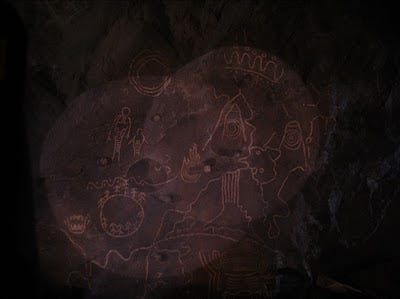
In Owl Cave, a petroglyph carved by ancient people depicts many things, like the Tall Man and Little Man, a waterfall (presumably the one by the Great Northern Hotel as seen in the opening credits), and the circle of trees as Glastonbury Grove.
Using this petroglyph, one can find the entrance to the Black Lodge (an otherplace where souls are banished and where dreams take us and where evil spirits seem to spend their “time”).
This means that the overall esoteric structure of the Twin Peaks universe existed in America before TV, before the Bomb, before electricity, and before settler colonialism.
What is that structure?
If we remember from the show, BOB seems to get into people through moments of trauma. Leland succumbed to BOB during his childhood when a neighbor of his grandparents threw matches at him (it’s often speculated that he was abused in other ways during these encounters with the stranger).
So, we have this structure of evil spirits entering people in times of trauma. This isn’t unlike plenty of figures from myths across many native tribes. The three most compelling for our purposes are:
The Nalusa Chito of the Choctaw enters into people once darkness sets into their minds (much like BOB tries to inhabit Laura).
The Wendigo of the Algonquians is a spirit that possesses people, pushing them to commit horrific acts (again, this describes BOB’s relationship to his victims).
The Raven Mocker of the Cherokee torments the dying and consumes their remaining lifespan, lengthening their own.
The tribes that told these tales are spread across the continent. The Choctaw originally lived in what is today called Alabama, Mississippi, and Louisiana. The Algonquian people? The Northeast US and Canada. The Cherokee people? The Eastern coast, including Virginia and the Carolinas.
It might be safe to say that this archetype is fundamental to the esoteric fauna of the land.
And what happens when they are stirred in mass number by the Bomb? They wake up to a world with a new conduit of electricity. They even find a dream world that goes beyond campfire stories to the must-see-TV shows that are beamed into hundreds of millions of homes simultaneously.
Finding such a playground, what would these spirits do?
And if you found out this was going on (say, like during a voyage to the field of unified consciousness at the basis of everything), what would you do?4
Tell It Like It Is
As we’ve seen, Twin Peaks is a show about the American dream world of TV. Inside that world, evil spirits have appeared to bring chaos and murder like the Wendigo, so that they may feed off the pain and sorrow they inflict—their precious garmonbozia—like the Raven Mocker. And they can even inhabit people during times of weakness, like the Nalusa Chito.
The existence of these kinds of beings is attested to in ancient tales. And their current stirring up by the Bomb is attested to in the television dream world of the late 80s and early 90s.
Twin Peaks tried to work deep magick, with a wizard and a shaman combining forces to make a counterbalancing ritual where Laura Palmer would be sacrificed in order to bring balance.
They used the same powerful new resources of electricity and TV. They even brought together the same archetypal beings and locations to do it all in.
As in, Laura Palmer’s ritual sacrifice in Twin Peaks the show is also literally her ritual sacrifice in the American dreamscape of TV (because it happened on the TV, it was spread through the airwaves and was powered by electricity).
But the ritual did not go as planned.
And we are living in the aftermath.
What happened when these magicians fought with ancient malevolent forces on the battlefield of the TV dreamscape that entered tens of millions of people’s minds?
More on that next time.
Of course, America’s Funniest Home Videos featured home video footage sent in by the viewers and then jazzed up a bit for a national television audience and hosted by none other than Bob Saget. This was the closest we had to scrolling TikTok at the time, so it’s no wonder that it garnered millions more viewers than the premiere of the most artistically sophisticated and spiritually important show in human history.
The argument could be made that wi-fi works similarly today. The shows from streamers are passing through the air as invisibly as back then and no doubt more commonly.
A reminder that the test site was chillingly named Trinity.
It should be noted that, as we saw in The Return, the Bomb awakened the Mother who gave birth to BOB and all number of these trauma-creating and suffering-devouring entities. The Mother is widely considered to be Judy (i.e. Joudy) that we hear about, first from Philip Jeffries in Fire Walk with Me. Mark Frost’s book Twin Peaks: The Final Dossier tells how the name JOUDY was found scrawled on the wall of Jeffries’ Buenos Aires apartment while he was on assignment investigating Judy. And Special Agent Tamara Preston, the fictional author of The Final Dossier, speculates that this could refer to an evil spirit entity known in ancient Sumeria. As Frost writing as Preston writes:
Joudy, it turns out, is also the name of an ancient entity in Sumerian mythology. (This dates back to at least 3000 B.C.) The name was used to describe a species of wandering demon—also generically known as an Utukku—that had "escaped from the underworld" and roamed freely throughout the earth, where they feasted on human flesh and, allegedly, ripped their souls from their victims which provided even more meaningful nourishment. They particularly thrived while feeding—and I quote—"on human suffering."